
Natural Jewellery: Bamboo, Wood, Shell and Raffia Explained
Material — Four natural surfaces, four different decisions
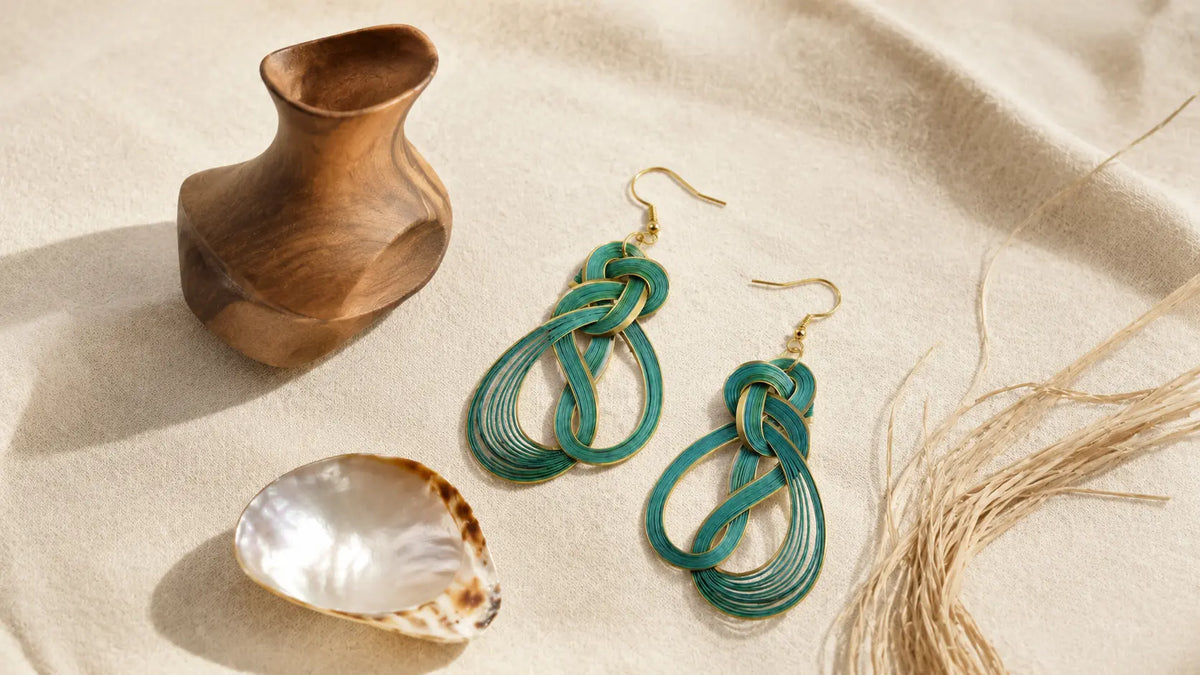
Natural jewellery is not one material category with one set of qualities. Bamboo, wood, shell and raffia may all bring texture and organic variation to jewellery, but they come from different sources, are shaped in different ways and need different forms of care.
The most useful way to compare them is not to ask which material is universally best. It is to look at structure, weight, surface, sourcing, finish and the way the piece will be worn.
This guide explains how four natural jewellery materials differ, what their appearance can reveal and which questions to ask before choosing a piece.
What Is Natural Jewellery?
Natural jewellery generally describes jewellery in which a visible part of the design is made from a material that originated in the natural world rather than being created entirely as a synthetic or industrial surface.
The term may include plant materials such as bamboo, wood and raffia, as well as animal-origin materials such as shell. It can also be used more broadly for stones, pearls, seeds, horn, bone and other organic or mineral components.
However, “natural” describes origin more readily than it describes the finished product. A natural component may still be dyed, sealed, laminated, polished, combined with metal or fixed with adhesive. The hooks, posts, chains and settings may come from completely different supply chains.
Natural jewellery should therefore be assessed as a complete object rather than judged by its most visible material alone.
How Should Natural Jewellery Materials Be Compared?
Source
First, identify what the material actually is and where it comes from.
Bamboo is a grass with woody culms. Wood is the structural tissue of trees and other woody plants. Raffia is a plant fibre obtained from raffia palm leaves. Shell is a biological mineral structure made by molluscs.
These distinctions matter because two materials can look similar after cutting, polishing or dyeing while behaving very differently in use.
Structure
Next, consider whether the material is solid, fibrous, layered or woven.
A carved wooden disc behaves differently from an open bamboo weave. A polished shell element reflects light differently from raffia fibre. Structure affects scale, movement, flexibility and the way an earring or pendant sits against the body.
Finish
Ask whether the visible surface is raw, polished, stained, painted, sealed, lacquered or coated.
A finish can deepen colour, protect a surface or change its sheen. It can also alter care requirements. A highly sealed wooden component should not automatically be cared for in the same way as unfinished raffia or open handwoven bamboo.
Weight
Material names alone do not determine weight.
Density, thickness, dimensions, metal fittings, stones and construction all matter. An open woven earring may create a large silhouette with relatively little material, while a compact carved form may feel denser despite being smaller.
Care
Natural materials respond differently to water, humidity, perfume, abrasion and pressure.
Good product information should explain how to clean and store the complete piece, including both the natural material and any metal components.
Bamboo Jewellery
Bamboo brings linear fibre, fine texture and structural lightness to jewellery. It can be cut, shaped, bent, carved or divided into narrow strips for weaving.
Bamboo Is a Grass, Not Wood
Bamboo is often grouped visually with wood because mature bamboo culms can be hard and woody. Botanically, however, bamboos belong to the grass family. The UBC Botanical Garden description of bamboo identifies bamboos as members of the grass family with thickened woody stems known as culms.
This is more than a botanical detail. Bamboo’s long fibre direction and hollow, segmented culm structure influence how it can be split and refined into workable strips.
How Bamboo Becomes Jewellery
In handwoven bamboo jewellery, solid bamboo is prepared into fine strips before it becomes a wearable form. The strips can cross, curve and hold tension, allowing the weave itself to become part of the structure.
A compact weave creates a more continuous surface. An open weave uses negative space to produce volume without filling the entire silhouette with solid material.
Read How Handwoven Bamboo Earrings Are Made for a closer look at preparation, weaving, shaping and finishing.
How Bamboo Looks
Bamboo can show fine longitudinal fibres, warm natural tones, narrow strip edges and visible crossing points. Handwoven pieces may also reveal slight changes in tension, curve and colour.
The result can feel tactile and sculptural without relying on high shine. It works particularly well in designs where the making process is intended to remain visible.
How Bamboo Feels
Prepared bamboo strips can create visually substantial forms while keeping much of the silhouette open. This makes bamboo useful for earrings that seek presence through structure rather than dense mass.
The final wearing weight still depends on size, fittings, finish and added stones. Product pages should provide measured weight rather than asking the customer to infer comfort from the material name.
How Bamboo Should Be Cared For
Bamboo jewellery should be kept away from prolonged moisture unless the maker provides different product-specific guidance.
Perfume and hairspray are best applied before putting the jewellery on. After wear, the bamboo surface can be wiped gently with a clean, soft and dry cloth, then stored away from humidity and pressure.
For a clearer explanation of the material itself, read Real Bamboo Earrings vs Bamboo-Style Hoops.
Wood Jewellery
Wood jewellery is usually shaped from a solid or laminated section of wood. It may be carved, turned, cut, engraved, inlaid, painted or polished.
Wood Is Not a Single Uniform Material
Different woods vary in density, colour, grain, hardness and dimensional behaviour. The US Forest Service guide to commercially important woods explains that differences in cellular structure and composition can make woods heavy or light, stiff or flexible, and hard or soft.
This means that “wooden jewellery” is only the beginning of a material description. The species, cut, thickness and finish can all affect the final piece.
How Wood Looks
Wood is often chosen for visible grain, tonal variation and the relationship between a carved shape and the pattern running through it.
A smooth polished surface may feel graphic and controlled. A hand-carved surface may retain tool marks and a more tactile character. Stain, paint or lacquer can either reveal the grain or partially obscure it.
How Wood Feels
Many wooden earrings feel lighter than similarly sized solid metal forms, but density varies significantly by species and construction.
Wood is particularly suited to flat silhouettes, carved pendants, beads and turned forms. It can create clean geometry, but a solid wooden element usually produces visual mass differently from an open bamboo weave or raffia construction.
How Wood Should Be Cared For
Wood is sensitive to changes in moisture, and finishes can react differently to cosmetics and abrasion.
Cleaning should follow the maker’s guidance. Soaking is generally inappropriate for jewellery made from wood, especially when the piece contains glued layers, painted detail or an unknown finish.
Storage away from direct heat, damp conditions and harder jewellery helps protect both surface and shape.
Shell Jewellery
Shell jewellery introduces a mineral surface formed by a living organism. It can be cut, pierced, polished, carved or used as a naturally shaped component.
What Shell Is Made From
Mollusc shells are largely built from calcium carbonate combined with an organic protein matrix. The Natural History Museum’s introduction to shells describes shell material as calcium carbonate and conchiolin, a tough protein.
This layered biological structure gives shell its combination of hardness, surface variation and potential brittleness.
How Shell Looks
Shell can appear softly chalky, highly polished, translucent, pearlescent or strongly patterned. Mother-of-pearl introduces iridescence, while other shell sections may show stripes, spots, ridges or natural curves.
Because the appearance is formed biologically, two pieces cut from the same type of shell may not match exactly in colour or pattern.
How Shell Feels
Thin shell elements can feel light, while thicker carved or layered pieces may feel denser. Their smoothness and cool surface distinguish them from fibrous plant materials.
Shell can create a refined reflective accent, but sharp edges, drilled holes and thin sections need careful finishing to reduce the risk of chipping.
Shell Sourcing Needs Particular Attention
Shell is not simply a decorative mineral. It comes from an animal and may be subject to wildlife-trade controls depending on species and origin.
UK government guidance notes that CITES controls can apply to jewellery and other products made from protected shells or coral. The GOV.UK guidance on CITES imports and exports should be checked when protected species may be involved.
A responsible seller should be able to identify the shell or explain the sourcing information available. Vague terms such as “ocean shell” provide little basis for evaluating origin.
How Shell Should Be Cared For
Shell should be protected from impact, hard abrasion and prolonged chemical exposure.
Perfume, hairspray and household cleaners may affect polish or surface colour. A soft dry cloth and separate storage are usually more appropriate than abrasive metal-polishing products.
Raffia Jewellery
Raffia introduces a softer, more visibly fibrous structure than bamboo, wood or shell. It is used in woven, wrapped, knotted and fringed forms.
What Natural Raffia Is
Natural raffia is a plant fibre obtained from raffia palm leaves. A Smithsonian collection record for raffia textile describes raffia as fibre obtained from the leaf of the raffia palm.
Raffia palms belong to the genus Raphia. Their long leaves provide strips and fibres that can be dried, divided and worked into flexible structures.
How Raffia Looks
Raffia usually has a dry, papery or straw-like texture, with visible fibre width and natural colour variation. It can be dyed, twisted or layered to create a fuller surface.
Its visual character is softer and more relaxed than polished shell or carved wood. The fibre itself remains the dominant feature.
How Raffia Feels
Raffia can create noticeable volume with very little weight. Fringes, wrapped hoops and woven forms can move easily and feel airy.
It is generally more flexible than carved wood or shell, but fine fibres can also be vulnerable to crushing, fraying and distortion.
Check Whether the Raffia Is Natural
The word “raffia” may be used loosely for a raffia-like appearance. Product information should state whether the material is natural palm fibre, paper raffia or a synthetic substitute.
This distinction affects texture, water response, durability and the accuracy of environmental claims.
How Raffia Should Be Cared For
Raffia jewellery should be protected from soaking, heavy pressure and repeated friction.
If the fibres become flattened, the appropriate reshaping method depends on the construction and finish. The maker’s instructions should take priority over general advice.
Store raffia pieces where fringes or woven forms will not be compressed by heavier jewellery.
Bamboo and Wood: What Is the Difference?
Bamboo and wood can both offer warm colour and visible fibre, but they are not interchangeable.
Bamboo Works Through Long Fibres and Strips
In woven jewellery, bamboo is refined into narrow strips that create form through crossing, tension and curvature. The material can remain visually linear even after the piece becomes three-dimensional.
This makes bamboo particularly suited to open structures where light passes through the design.
Wood Works Through Solid Form and Grain
Wood jewellery more often begins with a solid section that is cut, carved, turned or engraved. The grain remains visible within the mass of the object.
A wooden pendant may therefore feel more sculpted from a block, while a woven bamboo piece feels assembled through lines and spaces.
Choose According to Construction, Not Assumption
Choose bamboo when visible weaving, open volume and fine strip texture are central to the design. Choose wood when carving, solid geometry, beads or pronounced grain are more important.
Neither is universally lighter or more durable. The exact species, dimensions, finish and construction determine the finished result.
Bamboo and Shell: What Is the Difference?
Bamboo and shell offer very different relationships with light and surface.
Bamboo Absorbs and Softens Light
Natural bamboo usually has a matte or softly finished surface. Woven crossings create small shadows, and the warmth comes from fibre and tone rather than reflection.
Shell Reflects and Refracts Light
Polished shell can introduce gloss, translucency or iridescence. Even a small shell detail may become visually prominent because it catches light.
Choose According to the Desired Accent
Bamboo is suited to quiet texture, natural structure and a softer statement. Shell suits a cooler polished accent, organic pattern or luminous detail.
When the materials are combined, the product description should explain both their origin and the way each component is attached.
Bamboo and Raffia: What Is the Difference?
Bamboo and raffia are both plant materials that can be woven, but their physical character is distinct.
Bamboo Holds a More Defined Edge
Prepared bamboo strips can retain a crisp line, allowing the weave to create precise curves, compact surfaces and controlled open shapes.
Raffia Creates a Softer Fibre Surface
Raffia bends, wraps and gathers more like a flexible fibre. Its edges appear softer, and its movement can feel looser or more fluid.
Choose According to Silhouette
Bamboo suits a defined sculptural outline and visible structural rhythm. Raffia suits soft volume, fringe, wrapping and a more relaxed woven effect.
Both materials need protection from prolonged moisture and compression, but the appropriate care depends on the finish and construction of the individual piece.
Does Natural Mean Sustainable?
No. Natural origin does not automatically make jewellery sustainable or ethical.
A useful assessment considers sourcing, processing, dyes, coatings, adhesives, metal components, labour, transport, durability and end-of-life options.
Shell may raise wildlife-trade questions. Wood and bamboo require species and sourcing information. Raffia should be identified accurately rather than confused with paper or synthetic substitutes.
The article What Is Ethical Jewellery? explains how materials, makers, traceability and claims should be considered together.
A specific statement such as “main body made from natural bamboo with sterling silver hooks” is more useful than a broad description such as “completely eco-friendly jewellery”.
How to Choose Natural Jewellery
Begin With the Material Description
Look for the exact material rather than a visual phrase.
“Bamboo-inspired” may describe metal. “Wood effect” may describe printed resin. “Shell colour” does not confirm the presence of shell. “Raffia-style” does not establish whether the fibre is natural.
Separate the Main Body From the Findings
An earring can have a natural bamboo, wood, shell or raffia body while still using metal hooks, posts, backs and connecting rings.
Skin-contact materials should be identified separately, especially when the customer has sensitivities or preferences about metal.
Check Weight and Dimensions
Scale is difficult to judge from styled photography alone.
Look for length, width and measured weight. This is particularly useful when comparing carved wood, shell components and open woven earrings.
Look at the Finish
A natural material may be painted, sealed or coated. The finish affects appearance, care and the amount of the original surface that remains visible.
Close-up images should make this clear.
Read the Care Guidance Before Buying
Care instructions reveal how the maker understands the material.
A product that should remain dry, avoid cosmetics or be stored without pressure should say so before purchase rather than after damage occurs.
How to Style Natural Jewellery
Natural jewellery is most effective when its surface and construction are given space to be seen.
With Neutral Clothing
Bamboo and wood bring warmth to ivory, black, camel, navy and soft grey. Their grain and fibre can add depth without introducing a high-contrast metallic shine.
With Linen and Cotton
Plant-based jewellery works naturally with linen and cotton because the materials share a tactile, low-gloss character.
A sculptural bamboo earring can sharpen a simple linen dress, while raffia can create a softer and more relaxed effect.
With Evening Fabrics
Shell can create a luminous contrast against silk, satin or fine knitwear. Bamboo can offer a quieter sculptural counterpoint, particularly when the design uses open form and controlled proportion.
With Other Jewellery
When a natural-material earring already has scale or texture, other pieces can remain restrained.
A fine chain, simple ring or bare neckline usually allows the material to become the focal point without making the look feel overworked.
Bamboura’s Approach to Natural Jewellery
Bamboura focuses on real bamboo and handwoven structure rather than using “natural” as a broad decorative label.
The direction of the strips, the crossing of the weave and the space held within the form remain visible. This allows the material to contribute both surface and construction.
The relationship between bamboo fibre and wearable shape is explored further in Why Bamboo Structure Matters in Handwoven Accessories.
Small variations in tone, grain and weave are part of the character of natural bamboo, while product descriptions provide the specific dimensions, weight, fittings and care information needed to assess each piece.
Explore the Bamboura handwoven bamboo earrings collection for natural jewellery shaped through fine strips, open structure and contemporary form.
The same craft language can also be seen at a larger scale in the Bamboura bamboo handbag collection.
Frequently Asked Questions
Is Bamboo a Type of Wood?
No. Bamboo belongs to the grass family, although mature bamboo culms can be woody and used in ways that visually resemble wood.
Which Natural Jewellery Material Is Lightest?
There is no universal answer. Raffia and open bamboo structures can create volume with little material, but finished weight depends on dimensions, density, fittings, stones and construction.
Is Shell Jewellery Natural?
Yes, genuine shell is a natural material produced by a living organism. Its species, origin, finish and any wildlife-trade controls should still be considered.
Is Raffia the Same as Rattan?
No. Raffia is a fibre obtained from raffia palm leaves. Rattan is a climbing palm whose stems are used as a cane-like material. Their structure, appearance and uses are different.
Are Natural Earrings Suitable for Sensitive Ears?
The visible natural material does not answer this question by itself. Suitability depends largely on the hooks, posts, backs, coatings and other components that touch the skin.
Can Natural Jewellery Get Wet?
Care depends on the material and finish. Bamboo, wood and raffia are generally best protected from soaking, while shell should also be kept away from harsh chemicals and abrasion. Always follow the maker’s product-specific guidance.
Does Handmade Mean the Material Is Natural?
No. Handmade describes a production process. A handmade piece may contain natural, synthetic or mixed materials. The product description should identify both material and process separately.
Choose the Material, Not Just the Mood
Natural jewellery can be warm, polished, fibrous, sculptural or quietly reflective. Those qualities come from very different materials.
Bamboo offers visible line, woven structure and controlled open form. Wood offers grain and carved solidity. Shell offers a cool mineral surface and natural luminosity. Raffia offers soft fibre, movement and airy volume.
The best choice depends on the silhouette you want, how the piece will be worn and whether the material, finish, fittings and care have been explained clearly.
Explore Bamboura’s natural bamboo collections to see how handwoven structure can bring texture, lightness and contemporary shape to jewellery and accessories.
Bamboura
A modern bamboo atelier reimagining bamboo craft through contemporary design.
Email: service@bamboura.co.uk
Phone: +44 7962883533 (Mon-Fri 10:00-15:00 GMT)
BAMBOURA LTD