
How Handwoven Bamboo Earrings Are Made
Craft — From bamboo strip to wearable form
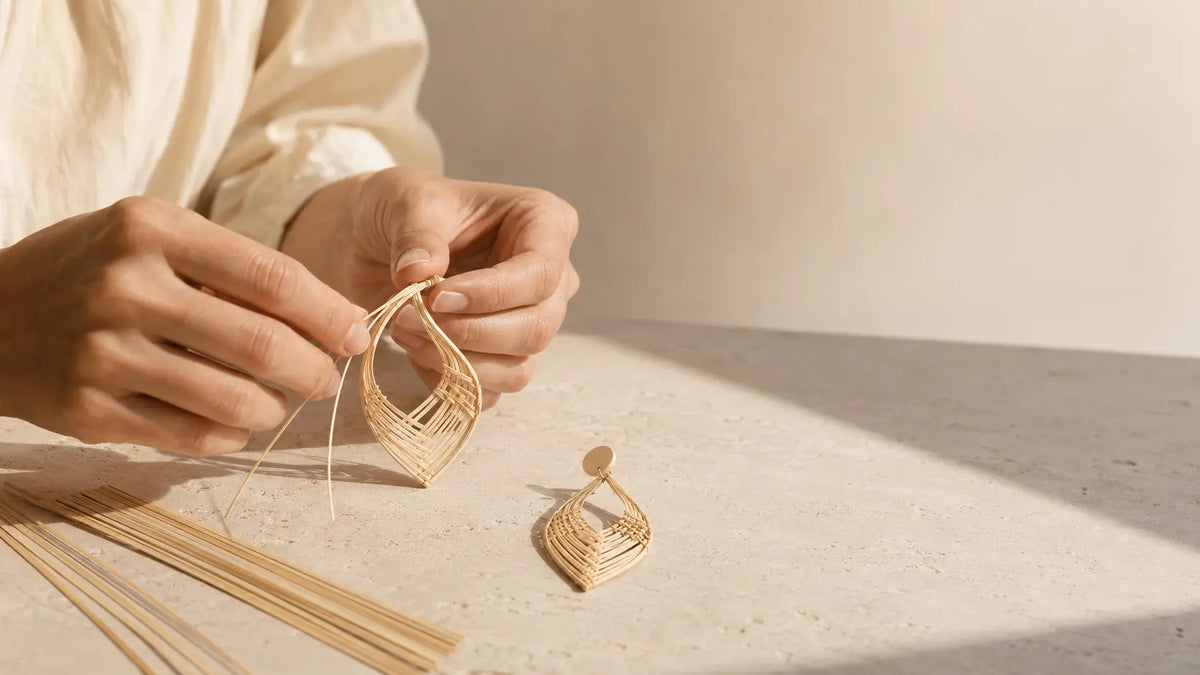
Handwoven bamboo earrings begin long before the first visible weave. Natural bamboo must be selected, divided into fine strips, prepared, woven, shaped and carefully finished before it becomes a piece of jewellery.
The exact process varies between designs. A compact woven drop requires a different structure from an open spiral, but both depend on precise material preparation and controlled handwork.
Here is how handwoven bamboo earrings move from bamboo to wearable form.
1. Selecting Bamboo for Fine Handwork
The process begins with bamboo that can be divided into clean, consistent sections.
Jewellery places different demands on bamboo from a basket, tray or larger decorative object. The scale is smaller, the curves are more precise and every detail is viewed at close range.
A strip that is too thick may resist shaping. A strip that becomes too thin may not hold the intended structure. The maker therefore considers the grain, surface and suitability of the bamboo before beginning.
Because bamboo is a natural material, subtle differences in tone and fibre can remain visible in the finished piece. These variations are part of the material rather than a surface pattern printed onto it.
2. Turning Bamboo into Fine Strips
A bamboo culm cannot be woven into an earring in its original form. It must first be cut into sections and divided along the direction of its fibres.
These sections are progressively refined into narrower strips. Each strip may then be shaved and smoothed until it reaches the width and thickness required by the design.
Consistency is important. Uneven strips can interrupt the rhythm of the weave, create bulky crossing points or make a curve more difficult to control.
The aim is not complete industrial uniformity. It is enough precision for the strips to work together while preserving the natural texture and character of bamboo.
This preparation is a significant part of bamboo jewellery craftsmanship, even though much of the work becomes almost invisible once the earring is finished.
3. Preparing and Weaving the Strips
Before weaving begins, the strips must be prepared for handling and shaping.
The exact method depends on the bamboo, workshop and design. It may involve smoothing, drying, curing or carefully controlled moisture or heat.
For a direct example of this process, explore the Cloud Drop bamboo earrings. The product page shows how bamboo is selected, divided into fine strips, refined, prepared, woven into form and secured at the edges.
Once prepared, the strips are arranged into the structure of the earring.
Bamboo weaving commonly uses a controlled over-and-under relationship, but making a small accessory requires more than repeating a basic crossing. The artisan must manage spacing, direction and tension within a compact form.
A dense weave creates a more continuous surface. An open weave allows negative space to become part of the design. Diagonal or layered crossings can introduce movement and visual rhythm.
The pattern is therefore structural as well as decorative. It influences how the earring bends, where it holds tension and how it maintains its silhouette.
For a broader explanation of the craft itself, read What Is Bamboo Weaving? A Simple Guide to the Craft.
4. Shaping the Earring
A woven surface is not yet a finished earring. It must be guided into a deliberate and wearable form.
Depending on the design, the bamboo strips may be curved into a drop, arranged into loops or brought together around a defined outline.
The maker has to consider the front view, side profile and movement of the piece because earrings are seen from several angles.
An open structure can create visual impact without becoming a solid mass. A more compact weave produces a clearer surface and stronger outer line.
In both cases, the silhouette grows from the behaviour of the bamboo strips rather than being added as a separate decorative shell.
This close relationship between material, structure and shape is what allows handwoven bamboo earrings to feel both natural and sculptural.
5. Securing the Edges and Adding the Fittings
Once the main form is complete, the loose ends and outer edges must be resolved.
Traditional bamboo craft includes different ways of turning, binding, locking or enclosing an edge. The specific method depends on the design, but its purpose remains consistent: the structure must stay secure and the outline should look carefully finished.
On a small earring, rough fibres, bulky joins or uneven ends are immediately noticeable. Finishing may therefore include trimming, smoothing and checking each point where the strips meet.
The completed bamboo form is then connected to hooks, posts, rings or decorative elements.
The position of the fitting affects how the earring hangs, moves and faces forward. A well-placed connection should support the structure without distorting the surrounding weave.
A clear product description should identify both the bamboo body and the material used for the hooks or fittings. Comfort and suitability for sensitive ears depend largely on these metal components rather than the bamboo alone.
Why Handmade Bamboo Earrings Vary Slightly
Natural bamboo does not have the completely uniform surface of a synthetic material. Grain, tone and fibre character may vary subtly between sections.
Hand weaving and shaping introduce another layer of variation. One curve may settle slightly differently, or one crossing may reveal more of a particular strip.
The two earrings should still feel visually balanced, but they may not be perfectly machine-matched.
These differences should not be confused with poor finishing. A well-made pair still requires clean edges, secure fittings and a controlled overall form.
Small variations are meaningful when they reveal real material and handwork rather than inconsistency in quality.
What to Check Before Buying Handwoven Bamboo Earrings
A useful product description should tell you more than the finished colour and shape.
Look for information about:
- whether the main body is made from real bamboo;
- whether the bamboo is woven, bent, carved or assembled;
- the materials used for the hooks and fittings;
- the dimensions and weight of each earring;
- the natural variations that may occur;
- the recommended care and storage method.
Close-up and process photographs are also valuable. They allow you to examine the bamboo strips, crossing points, edge finish and connection between the natural material and metal components.
The word “handmade” should be supported by visible information about the material and process, rather than used as an unexplained label.
Frequently Asked Questions
Are handwoven bamboo earrings made from real bamboo?
Genuine handwoven bamboo earrings use prepared bamboo strips as part of their main structure.
Check the product description carefully because “bamboo earrings” can also describe metal hoops with a bamboo-like surface texture.
Are all real bamboo earrings woven?
No. Real bamboo earrings may be woven, carved, bent or hand-shaped.
The construction method should be stated clearly so that shoppers understand how the bamboo has been used.
How are the edges kept from coming loose?
The ends are secured using a finishing method suited to the design. This may involve turning, locking, binding, trimming or enclosing the strips before the fittings are attached.
Why do handmade bamboo earrings look slightly different?
Small differences can result from natural bamboo grain and manual weaving or shaping. The pair should still remain balanced and consistent with the intended design.
From Bamboo Strip to Wearable Form
Making handwoven bamboo earrings is a sequence rather than a single decorative step.
Material selection determines what the bamboo can become. Strip preparation creates the foundation for an even weave. Weaving establishes the structure, shaping creates the silhouette, and careful finishing turns that structure into wearable jewellery.
This visible relationship between material, process and form gives genuine handwoven bamboo earrings their distinctive character.
Explore the Bamboura bamboo earrings collection to see how natural bamboo strips and hand-shaped forms are translated into contemporary jewellery.
Bamboura
A modern bamboo atelier reimagining bamboo craft through contemporary design.
Email: service@bamboura.co.uk
Phone: +44 7962883533 (Mon-Fri 10:00-15:00 GMT)
BAMBOURA LTD