
Bamboo Earrings Explained: Real Bamboo vs Bamboo-Style Hoops
Material — How to distinguish natural bamboo craft from bamboo-inspired metal hoops
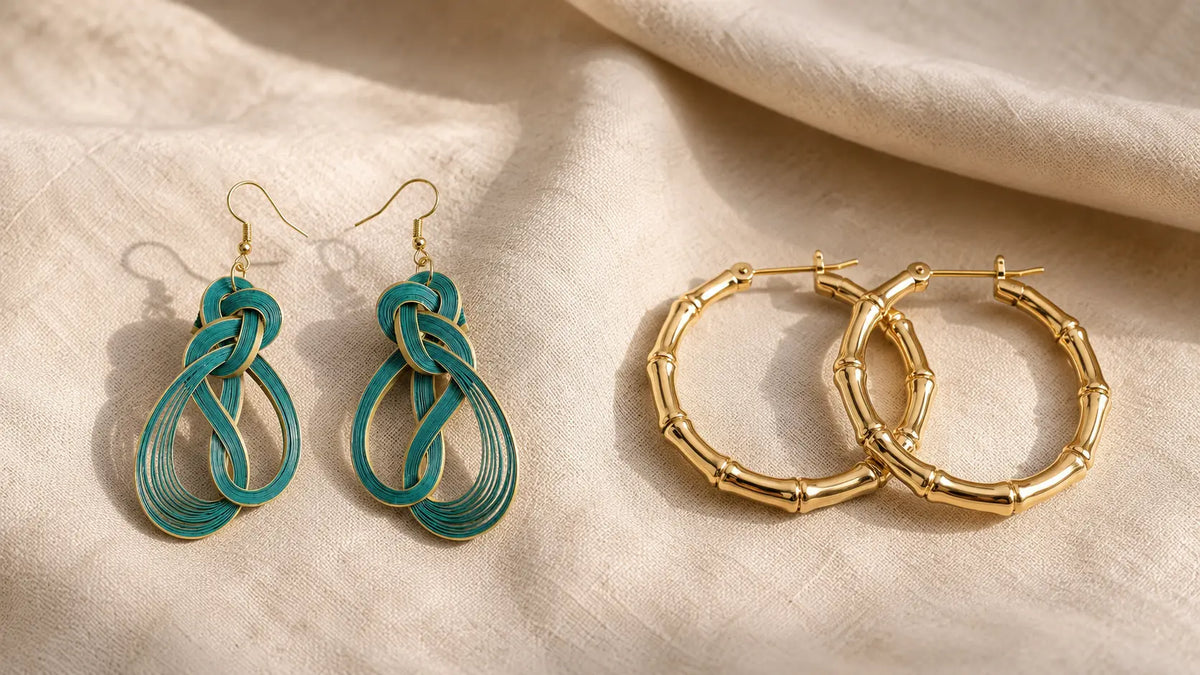
Clarity — Two meanings behind bamboo earrings
Search for bamboo earrings and you may find two very different kinds of jewellery.
Some are metal hoops shaped with raised sections that resemble the joints of bamboo cane. Others are genuinely made from bamboo, using the natural material as part of their structure, texture and design.
Both may appear under the same product name, but they are not the same material or craft. They feel different, require different care and belong to different design traditions.
This guide explains the difference between real bamboo earrings and bamboo-style hoops, what to check before buying, and how genuine bamboo can be shaped into contemporary jewellery.
Are Bamboo Earrings Actually Made from Bamboo?
Sometimes—but not always.
The phrase bamboo earrings may describe earrings made from genuine bamboo, earrings woven or shaped from prepared bamboo strips, or metal hoops with a segmented surface inspired by bamboo cane.
The word “bamboo” may therefore describe the material, the construction or simply the appearance.
A product title alone is not enough to confirm which meaning is intended. The full material description, detailed photographs and construction information should make the distinction clear.
What Are Bamboo-Style Hoops?
Bamboo-style hoops are usually metal earrings designed to imitate the segmented surface of bamboo cane.
They may be made from brass, stainless steel or another metal, then finished in gold, silver, enamel or decorative stones. Raised sections around the hoop reference the natural nodes found along a bamboo stem.
In this category, bamboo describes the visual motif rather than the physical material.
Bamboo-style hoops may be circular or oval, small or oversized, polished or textured. Some follow a classic hoop silhouette, while others take the form of door-knocker earrings or more elaborate statement pieces.
These earrings also have an established cultural history, particularly within Black and Latina fashion and late twentieth-century hip-hop style. That history is separate from the material story of earrings physically made from bamboo and should not be reduced to a temporary natural-material trend.
A metal bamboo hoop is not a less authentic version of a real bamboo earring. It belongs to a different design category with its own materials, appearance and cultural context.
What Are Real Bamboo Earrings?
Real bamboo earrings use bamboo as part of the physical structure of the piece.
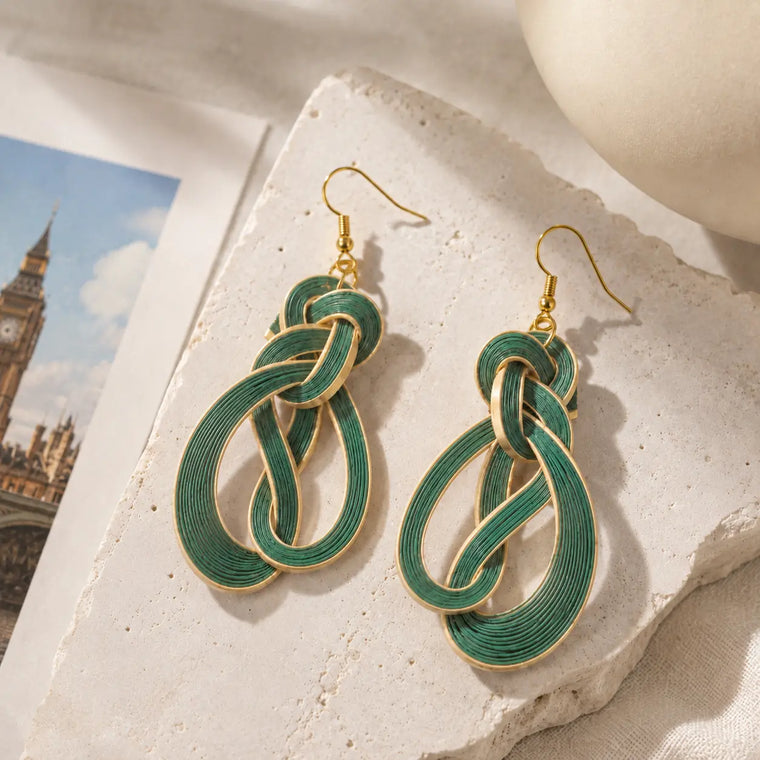
Depending on the design, bamboo may be cut into a flat form, carved, shaped, bent with controlled heat, divided into narrow strips or woven into an open structure.
Rather than reproducing the appearance of bamboo in metal, these earrings work with the material’s own fibres, tone and flexibility.
Real bamboo pieces may show visible fibres, woven intersections, subtle variations in colour, the edges of prepared strips and small differences between handmade forms. Their surfaces are often matte or softly finished rather than highly reflective.
Not every real bamboo earring is woven. Some may be carved, bent or assembled. A clear product description should explain how the material has been used.
To see how prepared strips move from raw material to finished form, read How Handwoven Bamboo Earrings Are Made.
Real Bamboo and Bamboo-Style Hoops Compared
The most obvious difference is the material, but it is not the only distinction.
Material. Real bamboo earrings contain genuine bamboo in their main form. Bamboo-style hoops are commonly made from metal, with bamboo used as a visual reference.
Surface. Real bamboo may reveal fibres, natural colour variation and woven detail. Metal bamboo hoops often have a polished, plated or uniformly coloured surface.
Construction. A metal hoop may be cast, formed or assembled into a regular silhouette. A handwoven bamboo earring builds its shape through prepared strips, crossing points, tension and carefully finished edges.
Visual character. Metal bamboo hoops often create impact through shine, scale and a recognisable segmented outline. Real bamboo creates a quieter sense of presence through texture, shadow, natural variation and visible craft.
Care. Metal plating and natural bamboo respond differently to moisture, cosmetics, abrasion and storage. Care instructions should reflect the actual material rather than relying on the shared product name.
Context. Bamboo-style metal hoops carry an important fashion history. Real bamboo earrings belong to a separate conversation about natural materials, handwork and contemporary bamboo design.
Clear product information should respect both distinctions.
How Can You Tell Whether Earrings Are Made from Real Bamboo?
Before buying, look beyond the product title.
Read the Full Material Description
Look for precise wording such as “made from real bamboo”, “natural bamboo”, “handwoven bamboo”, “prepared bamboo strips” or “bamboo body with metal fittings”.
Descriptions such as “bamboo-inspired”, “bamboo design” or “bamboo texture” may refer only to the appearance.
A transparent product description should identify the material used for the main body as well as the hooks, posts, connecting rings and decorative components.
Examine Close-Up Photographs
Detailed images should make the surface visible.
Real bamboo may show fibres, strip edges, crossing points or small variations in tone. Metal bamboo-style hoops are more likely to show a consistent plated finish and regularly repeated raised sections.
Distant styling photographs can show scale and proportion, but they may not provide enough detail to confirm the material.
Look for Evidence of the Making Process
When a product is described as handmade or handwoven, the brand should explain what that means.
Useful information includes how the bamboo is prepared, whether it is cut, bent, carved or woven, where the handwork takes place, how the shape is constructed and how the fittings are attached.
The word “handmade” becomes more meaningful when it is supported by visible information about the material and process.
Bamboura’s introduction to bamboo weaving and its structural principles explains how repeated strips can build form rather than simply decorate a surface.
Check the Findings Separately
Even when the visible body is made from bamboo, the hooks, posts, backs and connecting rings are usually separate components.
A complete product page should identify the materials that come into contact with the skin.
Do not assume that a natural bamboo body means the entire earring is metal-free or suitable for every sensitive ear. Comfort and skin compatibility depend largely on the fittings, coatings and individual wearer.
Check the Weight and Dimensions
Real bamboo can provide a light foundation for larger designs, particularly when fine strips and open structures are used.
However, bamboo does not automatically make every earring lightweight.
The finished weight also depends on the size of the design, the amount of bamboo used, whether the structure is solid or open, the metal fittings and any stones or decorative additions.
Measured product information is more useful than vague descriptions such as “weightless”. Look for the weight of one earring or one pair together with the length and width.
Read the Care Instructions
Real bamboo and plated metal should not be cared for in exactly the same way.
A responsible product page should explain whether the bamboo has a surface finish, whether contact with water should be avoided, how the earrings should be cleaned and how open woven structures should be stored.
For more detailed guidance on water, humidity and accidental moisture, read Can Bamboo Earrings Get Wet?
How Are Handwoven Bamboo Earrings Made?
Handwoven bamboo earrings begin with solid bamboo rather than fabric or a ready-made synthetic sheet.
The bamboo must first be selected and divided along the direction of its fibres. These sections are progressively refined into narrower strips suitable for small-scale work.
The strips need to be consistent enough to cross and curve cleanly while retaining the natural character of the material.
Once prepared, they can be woven under controlled tension. The maker must consider strip width, spacing, direction, crossing points, edge tension and the final silhouette.
A compact weave creates a more continuous surface. An open weave allows negative space to become part of the design.
The woven structure is then shaped, secured and finished before hooks, posts or connecting elements are added.
The visible pattern is not a printed decoration. It is part of the construction that allows the earring to hold its form.
Why Do Handmade Bamboo Earrings Vary Slightly?
Bamboo does not have the completely uniform surface of a synthetic material.
Grain, fibre and tone can vary between sections of the same plant. Manual preparation and weaving add another layer of subtle variation.
One curve may settle slightly differently. A crossing point may reveal more of one strip. The two earrings should still feel visually balanced, but they may not be mechanically identical.
These differences should not be confused with poor finishing.
A well-made pair should retain controlled proportions, clean edges, secure fittings, a balanced silhouette and consistent overall quality.
Small variations become meaningful when they reveal genuine natural material and handwork rather than inconsistency in construction.
Are Real Bamboo Earrings Lightweight?
They can be, but size and material are only part of the answer.
Bamboo strips and open woven structures can create visual scale without filling the entire silhouette with solid mass. This makes bamboo relevant to sculptural earrings designed to appear expressive without unnecessary heaviness.
The wearing experience also depends on the measured weight, the position of the fitting, the length of the earring, how far the form sits from the ear, movement during wear and any additional metal or stone components.
A large bamboo earring may feel comfortable when its structure is open and well balanced. A smaller piece may feel heavier when it includes dense decorative materials.
The correct conclusion is not that all bamboo earrings are weightless. It is that bamboo gives designers the possibility of creating form through fine material and open structure.
Explore the Bamboura bamboo earrings collection to view individual materials, dimensions and design details.
Real Bamboo Is Not Bamboo Viscose
Real bamboo jewellery should also be distinguished from bamboo-derived textiles.
Bamboo viscose is a regenerated fibre made from processed bamboo pulp. It is commonly used in clothing, bedding and other soft products.
Handwoven bamboo earrings use prepared sections or strips of solid bamboo as the visible material and structure. They are not made from bamboo fabric and are not woven from regenerated textile fibres.
The two materials begin with bamboo but undergo very different forms of processing and result in completely different products.
This distinction matters because broad phrases such as “made from bamboo” can otherwise make unrelated materials appear equivalent.
How Should Real Bamboo Earrings Be Cared For?
Always follow the instructions provided for the individual pair.
Unless the maker gives different guidance, natural bamboo earrings should not be soaked in water or worn while showering or swimming.
Perfume, hairspray and other cosmetics are best applied before the earrings are put on. If the bamboo comes into brief contact with moisture, it should be dried gently and promptly.
A clean, soft and dry cloth is generally more appropriate for the bamboo surface than a liquid jewellery cleaner intended for metal.
Store the earrings separately from harder jewellery to reduce abrasion. Open or woven structures should also be protected from pressure that could alter their shape.
The bamboo body and metal findings may require different care, so both parts should be considered.
How Do Real Bamboo Earrings Fit into a Modern Wardrobe?
Real bamboo earrings work particularly well when their natural surface is allowed to remain visible.
They can add texture to a crisp white shirt, a simple linen dress, black or ivory knitwear, neutral tailoring or a restrained evening outfit.
When an earring already has a sculptural outline, other jewellery can remain quiet. A bare neckline or fine chain allows the material to become the focal point without making the outfit feel overworked.
The result does not need to feel rustic or overtly bohemian.
Controlled proportions, clean clothing and a refined silhouette can place handwoven bamboo within a modern wardrobe. The material brings warmth, while the overall styling remains calm.
For practical combinations with white shirts, linen and neutral clothing, read How to Style Bamboo Earrings Without Overdressing.
Which Type of Bamboo Earring Is Right for You?
Neither category is inherently better. They answer different material and aesthetic preferences.
Bamboo-style metal hoops may suit someone looking for a polished metallic finish, a graphic hoop silhouette, a repeated bamboo-node texture or a nostalgic statement accessory.
Real bamboo earrings may suit someone who values genuine natural material, visible fibres, woven structure, tactile texture, subtle handmade variation and jewellery that works naturally with linen, tailoring and neutral clothing.
The most important point is clarity.
Someone searching for a gold bamboo hoop should not be led to believe that the product contains natural bamboo. Someone looking for genuine bamboo craftsmanship should not have to infer the material from an ambiguous title.
Bamboura’s Approach to Real Bamboo Earrings
Bamboura works with real bamboo as a material rather than using bamboo only as a decorative reference.
The fibre, flexibility and texture of bamboo influence how each design is prepared, woven and shaped. Fine strips can become compact surfaces, open forms, curved drops or sculptural outlines.
The purpose is not to make bamboo look like metal or to hide its natural identity.
Its character remains visible in the direction of the strips, the rhythm of the weave, the interaction of light and shadow and the small variations of a handmade surface.
Learn more about Bamboura’s approach to bamboo heritage and contemporary design.
Frequently Asked Questions
Are Bamboo Hoop Earrings Made from Bamboo?
Not necessarily.
The phrase often describes metal hoops with a segmented bamboo-inspired surface. Check the product description to determine whether bamboo is physically present.
Are All Real Bamboo Earrings Woven?
No.
Real bamboo earrings may be woven, carved, bent, cut or assembled. The construction method should be stated clearly.
Are Real Bamboo Earrings Always Handmade?
No.
“Real bamboo” describes the material, while “handmade” describes the production process. Each claim should be supported separately.
Are Bamboo Earrings Suitable for Sensitive Ears?
That depends mainly on the hooks, posts, backs, coatings and other components that touch the skin.
The bamboo body alone cannot determine whether a pair is suitable for sensitive ears.
Can Bamboo Earrings Get Wet?
Care depends on the construction and surface finish.
Unless the maker states otherwise, avoid soaking natural bamboo earrings and dry them promptly after accidental contact with moisture.
Do Real Bamboo Earrings All Look Identical?
Natural material and handwork can create small variations in tone, fibre and structure.
These differences should remain within the intended design and quality standard.
How Should Bamboo Earrings Be Cleaned?
Follow the instructions for the individual product.
A soft, dry cloth is generally more appropriate than liquid metal jewellery cleaner for the bamboo surface.
Material Should Be Stated, Not Assumed
“Bamboo earrings” can describe two very different objects: earrings made from bamboo and earrings made to look like bamboo.
A clear product description should state which one it is.
For Bamboura, that distinction is essential. Real bamboo, visible handwork and modern form should be supported by close-up detail, transparent material information and practical care guidance.
Understanding the difference allows you to choose according to material, craft and style rather than discovering after purchase that the product is not what its name appeared to promise.
Explore Bamboura’s handwoven bamboo earrings to see how natural bamboo can be translated into light, tactile and contemporary jewellery.
Bamboura
A modern bamboo atelier reimagining bamboo craft through contemporary design.
Email: service@bamboura.co.uk
Phone: +44 7962883533 (Mon-Fri 10:00-15:00 GMT)
BAMBOURA LTD